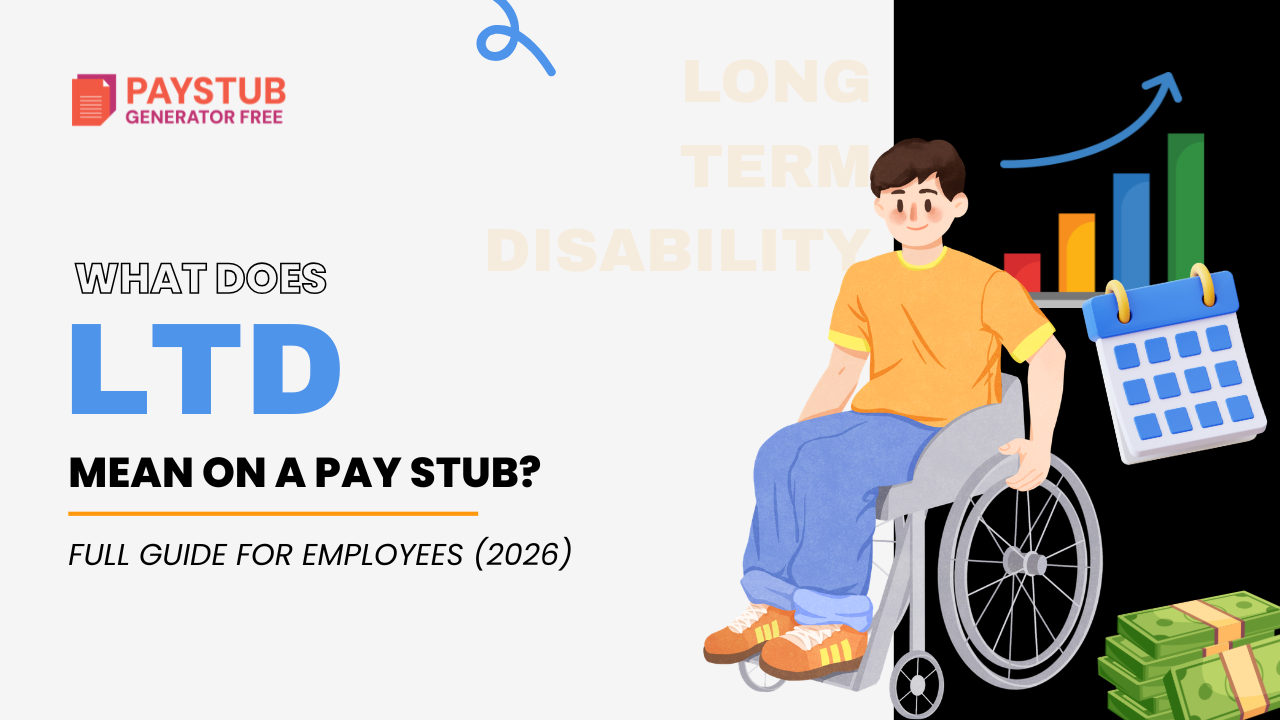
Long Term Disability Insurance (LTD) serves as a crucial financial safeguard for employees who are unable to work due to illness or injury for a specific period of time. LTD deductions are the portion of an employee’s income that is withheld to fund any potential insurance coverage, which the employee might need moving forward.
In this guide, you will be learning about what is LTD on paycheck stub and how it helps employees in seeking coverage and employers offering benefits as part of the compensation package for employees. Take control of your paycheck insights, use a free paystub generator to quickly identify and understand LTD deductions.
What is LTD on Paystub?
LTD on paystub stands for Long-Term Disability Insurance. This is a workplace benefit designed to provide you with earnings replacement if you’re unable to work due to serious illness or injury, which keeps you off the job for an extended period, generally longer than three to six months.
There is a waiting period, which is known as the elimination period, that is 90 to 180 days. During this period, you might use your sick days or disability benefits if they’re available.
How LTD shows on a pay stub depends on how your coverage is set up. If you and your employer share the cost of LTD insurance, you will likely witness a deduction from your pay, which is labelled as LTD insurance.
If you’re buying an individual disability insurance policy, you will choose the benefit length, which is the number of years that you can receive benefit payments, such as coverage to age 65.
How does Long Term Disability Insurance Work?
You have to document your illness and wait for your approval from the insurance company to qualify for long-term disability benefits. Once approved, the LTD on paycheck pays a percentage of your wages after the elimination period is over, up to the extent of your coverage period.
When you buy a single long-term disability policy, you choose the elimination period, which is the time between when you’re unable to work and when the disability payment begins.
Longer elimination periods mean cheaper periods, but you sacrifice prompt disability payments. Long-term disability insurance typically replaces 40% to 65% of your pre-disability income, depending on the policy and employer benefits package. However, some enhanced or private plans can offer coverage of up to 70% to 80%, usually with higher premium terms.
What does Long-Term Disability Insurance Cover?
Long-term disability insurance can cover the disabilites which is caused by a range of injuries. These include:
- Brain injuries
- Burns
- Cancer
- Kidney disease
- Heart attack
- Mental health issues
- Musculoskeletal disorders like chronic neck and back pain
The insurance policy’s definition of a disability is what you want to understand when buying a policy.
When do you qualify for Long-Term Disability Insurance Payments?
If you’re diagnosed with a life-threatening illness, it does not mean you automatically qualify for payments. An insurer will investigate if your injury or illness completely prevents you from working either in your current occupation or in any job. Terms like own-occupation and any-occupation will have a major impact on your eligibility for disability benefits and your premium amounts.
For example, if you become disabled and are unable to carry out the duties of your particular job, but you are capable of performing other roles within your company, your claim for long-term disability benefits could be rejected by the insurer if you are covered for any-occupation only.
Having a diagnosis of a severe or terminal illness is not a solid basis to receive payments. There are other insurance policies available that can financially support you if you are worried about the potential loss of income due to a medical condition in the future.
What is LTD on W2?
LTD on W2 is defined as the Long-Term Disability Insurance, but it does not always appear on your paystub clearly labeled as the LTD box on the form.
LTD shows up indirectly in how your wages are reported:
- If your employer pays the LTD premium, the cost might be included in your taxable wages.
- If you pay the LTD premiums yourself using after-tax income, the benefits you receive later are tax-free.
- LTD-related amounts might appear in Box 12 with a particular code, depending on how the benefit is structured.
What is LTD ER on paystub?
LTD ER on paystub stands for Long-Term Disability Employer Paid. It means your employer is paying for your long-term disability insurance coverage, rather than deducting it from your salary.
If you see LTD ER on paystub, it includes:
- The premium is being covered by your employer
- It might appear as a benefit and not a deduction
- The value can be added to your taxable income
If your employer pays for LTD, any benefits you receive in the future are generally taxable.
Tip: Before finalizing your records, you can use a paystub template to preview how your information should appear. This ensures all your data is accurate and professional before you submit it for official use.
Eligibility Criteria for Long-Term Disability Deductions
For Long-Term Disability deductions to apply, employees should qualify for the Long-Term Disability benefits. To qualify for Long Term Disability, employees must meet various criteria that are set forth by insurance providers. The variation among insurers commonly surrounds the following elements:
- Employment status: Individuals should be employed by an organization that offers LTD coverage as part of its employee benefits package.
- Period of waiting: LTD policies have a waiting period, which is known as the elimination period, during which employees must be unable to work due to their disability before they can become eligible for LTD benefits.
- Medical evidence: Employees will be required to provide medical evidence to support their claim for LTD benefits.
What Is LTD in Paystub Deductions and How They Work?
Usually, when LTD is indicated as a deduction, it means the amount is deducted from your salary to finance your disability insurance. Some organizations cover the entire premium for you, some split the cost with you, and there are some instances where you are responsible for the whole premium.
The deduction is normally made out of your post-tax income. It is important because it affects the tax treatment of your disability benefits if you claim them in the future.
If you are paying through after-tax money, your long-term disability (LTD) benefits later on will generally not be subject to taxation. Conversely, in the case that your employer is making the payments, you might be taxed on the benefits.
Confused about LTD deductions on your paycheck?
Try our free payroll stub generator today and discover how easy payroll can be!
How LTD Contributions Impact Your Taxes?
LTD contributions play a vital role in how disability benefits are taxed if you ever need to claim them. The rule is simple: whoever pays the premium, how they pay, and determines if the benefit is taxable.
If your company covers 100% of your insurance premium, or if the amount you personally contribute is taken from your salary beforehand without taxes, it implies that the compensation from disability pay you might receive in the future will be subject to taxation.
However, in case you pay your part with taxed money, it is quite common that such disability benefits are tax-exempt. The difference between these two scenarios might turn out to be a substantial point in terms of your net income if you have to depend on long-term disability benefits, potentially amounting to thousands of dollars.
Taxes Important
Learning about the tax status of LTD benefits is important because it affects your financial recovery during a disability. If benefits are taxed, the monthly amount you receive could be reduced, which might not match your current lifestyle. Planning helps prevent financial strain when your health already demands your focus.
Reporting Contributions
Reading your T4 slip will help you understand the financial treatment of your LTD cover under the law. The sums paid by the employer could be recorded in Box 14 (employment income) or Box 40 (other taxable benefits). However, if the premiums are deducted from your after-tax income, likely, the figures will not be seen on the T4 unless they are included in the taxable benefit package.
Claiming Premiums
While you may be paying the premiums yourself, long-term disability (LTD) insurance premiums are not deductible from your medical or other expenses on your tax return. Employees deem LTD insurance premiums as non-deductible. Therefore, your investment gives you security and tax-free benefits without instant tax relief in the form of deductions.
Provincial Differences
Although the bulk of LTD is regulated through federal tax laws, the subtleties of a province can interfere with the way you report, your selection for the availability of the top-up programs, or how you are combined with other income supports. For example, the disability plans in Quebec have some structural differences because the region has its own payroll taxes.
Key Takeaways
Long Term Disability insurance serves as a crucial financial safeguard for employees incapacitated by disability, offering vital protection against income loss. Grasping the elaboration of LTD deductions is pivotal for both employees seeking coverage and employers integrating benefits.
By carefully evaluating eligibility criteria, tax implications, deduction limits, and other crucial factors, individuals and employers can make well-informed decisions regarding LTD coverage that align with their specific needs and objectives. Consulting with insurance professionals, tax advisors, and financial experts can provide valuable support in navigating the complexities of Long Term Disability deductions and maximizing the benefits of coverage.
FAQs
1- What is LTD on a pay stub?
LTD on a pay stub stands for Long-Term Disability, which is a payroll deduction for insurance that provides income if you cannot work for an extended period due to illness or injury.
2- What is STD deduction on paystub?
A standard deduction is a fixed, flat amount that reduces a taxpayer’s taxable income, simplifying the tax filing process by eliminating the need to itemize specific expenses.
3- What is LTD paycheck deduction?
An LTD paycheck deduction refers to Long-Term Disability Insurance, which is an employer-provided deduction that covers a percentage of your wages if you become too sick to work for an extended period.
4- What is LTD post tax meaning?
LTD post tax means Long-Term Disability insurance premiums, which are deducted from an employee’s paycheck after income taxes have been withheld.
5- What is LTD imputed meaning?
LTD imputed income refers to the taxable value of employer-provided Long-Term Disability Insurance premiums when the employer pays the premiums, but the benefit would be tax-free to the employee.
6- What is LTD medical meaning?
LTD medical means an insurance benefit that provides income replacement for employees who are unable to work due to illness.
7- What is LTD imputed income on paystub?
LTD imputed income on paystub showcases the taxable value of employer-paid, long-term disability insurance premiums.
8- What is LTD benefits meaning?
LTD benefits are insurance payments that replace a part of an employee’s income if they cannot work for an extended period of time due to severe illness.
9- How long does LTD last?
Long-term Disability lasts for a set number of years, like 2, 5, or 10 years.
10- What is LTD on my paycheck?
LTD on my paycheck stands for Long-Term Disability Insurance.