
Have you ever checked your paycheck and felt something wasn’t quite right? Maybe a raise didn’t reflect on time, or your hours were miscalculated. Situations like these are more common than you think, and they can leave employees confused and frustrated. That’s where paystub creator free can help, making it easier to create accurate paystubs for your business and avoid payment issues.
In this blog, we will be talking about retro pay, the SSA Fairness Act retroactive payments, and retro payment.
What is Retro Pay?
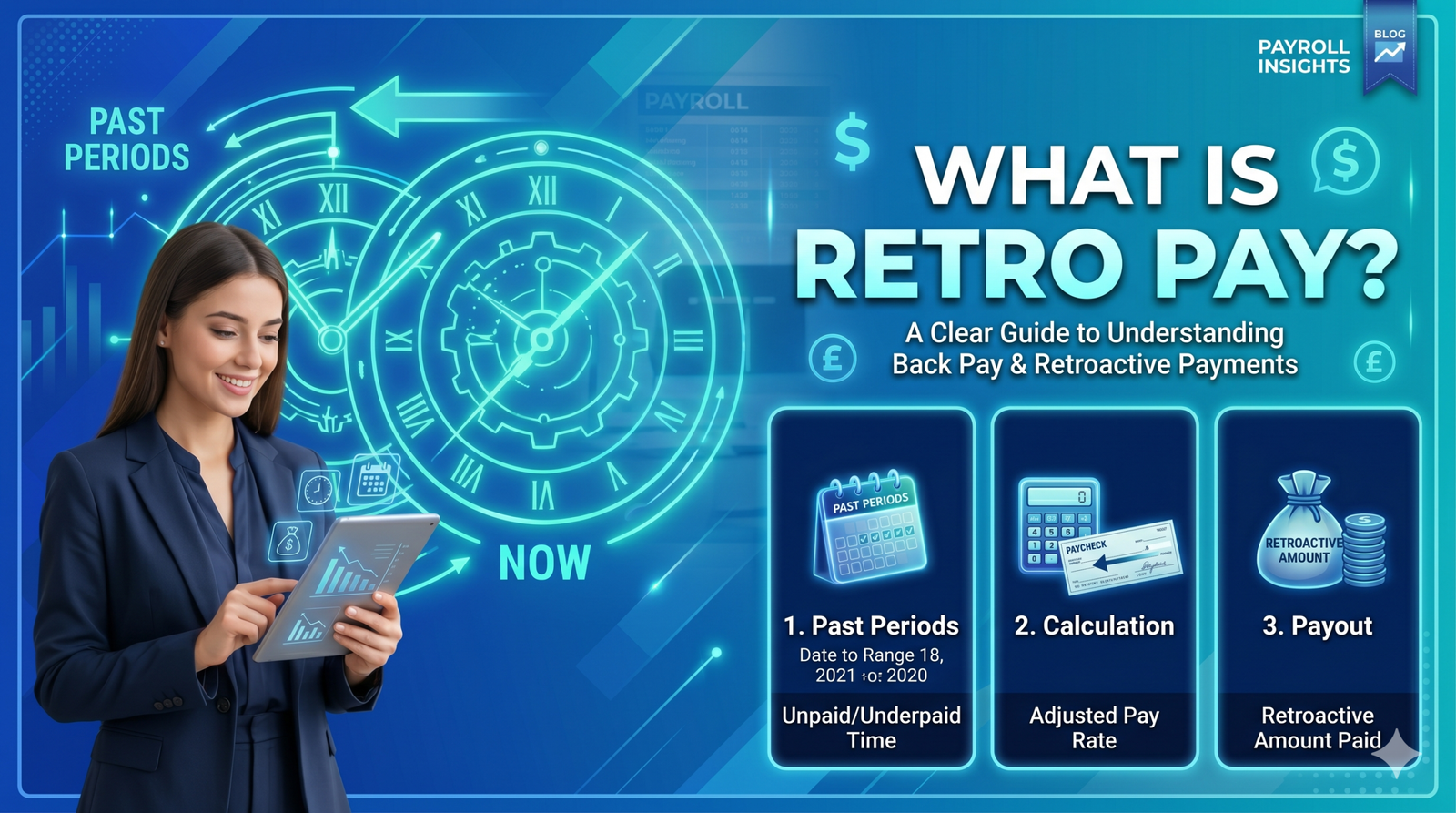
Retro Pay is extra money paid to an employee when they were underpaid in a previous pay period. It corrects payroll mistakes like missed raises, wrong pay rates, or unpaid overtime.
It is important to note that retro pay is not the same as back pay, which is known as the latter, which refers to wages owed due to legal disputes.
When is Retro Pay Needed?
Retro Pay is used whenever an employer owes wages to an employee for work performed in a prior pay period. The need for retro pay means any one of the following could have happened:
- The employer forgot to include an employee’s bonus
- The employee’s overtime pay was left out of their paycheck
- The employer forgot to include a shift differential
How to Calculate Retroactive Pay?
The method for calculating retro pay depends on the employee’s pay body and the nature of the discrepancy. Below we have shown the calculation:
Formula: Retro Pay = (Correct Pay Rate − Old Pay Rate) × Hours Worked
Steps to calculate retroactively pay:
- Identify the correct payment
- Determine the correct rate
- Calculate the difference
- Multiply by affected hours
- Deduct applicable taxes
You can easily simplify your calculations by using the payback period calculator. This tool helps in avoiding manual errors and ensures compliance is maintained.
Hourly Employees
- Calculate the difference between the correct and incorrect hourly rates.
- Multiply the number of hours worked during the affected pay periods.
Example:
An employee who has worked 80 hours for two pay periods was paid $18/hour instead of their recently approved $20/hour rate.
- Rate difference = $20 – $18 = $2/hour
- Hours worked = 80 hours
- Retro pay owed = $2 * 80 = $160
For hourly employees, it is important to double-check for overtime wages.
Salaried Employees
The calculation involves the rotation of the salary difference over the affected pay periods:
- Annual difference = $66,000 – $60,000 = $6,000
- Per-period difference = $6,000 / 26 = $230.77
- Retro pay owed: $230.77 * 2 = $461.54
Why Do Employers Pay Retro Pay?
Employers’ retro pay occurs when an employee does not receive the correct amount of wages in previous pay periods and is needed to compensate for the difference.
Below are some of the main reasons why retro pay happens:
Delay in pay raise
- If you were supposed to get a raise on an earlier date but payroll arrived later, the employer pays the difference.
Incorrect pay rate
- Payroll errors happen, such as being paid at the wrong hourly rate.
Bonuses
- If the bonus was calculated incorrectly, the missing amount is paid as retro pay.
Shift differential
- If you have been entitled to extra pay for an overnight shift and it wasn’t included, retro pay comes to your rescue.
Payroll errors
- Simple errors like missing hours are the most basic reasons for retroactive payments.
Retroactive Pay vs. Back Pay
Although both retro pay and back pay deal with employees who are not receiving their full outstanding salary, retro pay and back pay apply in different circumstances. Below, we have differentiated between retro pay and back pay:
| Factors | Retro Pay | Back Pay |
|---|---|---|
| Why is it needed? | Correct the miscalculation in an employee’s paychecks | For compensating an employee for wages that were calculated correctly but never received |
| What is the amount involved? | The difference between what the employee was paid and what they should have been paid | The full amount of wages that the employee didn’t receive |
| What does it compensate for? | The difference from the previous pay period is due to changes in missed earning items | Unpaid wages owed to an employee due to errors or disputes |
Retro Pay Example 1
John works as a full-time employee earning $20 per hour. In January, the employer increased their pay rate to $22 per hour, but the update was not applied until February. John worked 80 hours during that period at the old rate.
Step 1: Calculate the pay difference.
New rate – Old rate = $22 – $20 = $2 difference per hour
Step 2: Multiply by hours worked
$2 * 80 = 160 retro pay
So, John will receive $160 in retro pay to cover the underpayment from January.
Tip: Before finalizing your records, you can use a paystub template to preview how your information should appear. This ensures all your data is accurate and professional before you submit it for official use.
Retro Pay Example 2
Sarah is a salaried employee who earns $3,000 per month. In March, her employer approved a raise to $3,300 per month, but the payroll system was not paid until May.
Step 1: Calculate the monthly difference
New salary – Old salary = $3,300 – $3,000 = $300 per month
Step 2: Multiply by the affected months
$300 * 2 = $600 retro pay
So, Sarah will receive $600 in retro pay for compensating the delayed salary increase.
Want to avoid retro pay issues in your business?
Paystub Generator Free helps you generate accurate paystubs and prevent payroll errors.
SSA Fairness Act Retroactive Payments
The Social Security Fairness Act was signed into law on 5th January 2025 by former President Joe Biden, after it was passed by the Senate in December and the House in November.
The Social Security Retroactive Payments Act removed two rules:
- WEP (Winfall Elimination Period)
- GPO (Government Pension Offset)
These rules were reduced to Social Security benefits for many workers, such as:
- Police officers
- Teachers
- Firefighters
These reductions have been removed, which means that the people get their full benefits.
What has changed in 2026?
The Social Security Fairness Act permanently repeals the WEP and GPO; these two provisions have reduced the social security benefits for public workers who also receive a government pension.
The WEP affected the retired workers with both covered and non-covered employment. The GPO or survivor benefits by two-thirds of the value of a government pension. In most cases, it completely wipes out the benefits for surviving spouses. This means that:
- Your Social Security retirement benefits would no longer be reduced due to a government pension.
- If you qualify for survivor benefits, they will be paid in full.
What are the Social Security Retroactive Payments WEP GPO?
WEP (Windfall Elimination Provision)
- Reduced your own Social Security retirement benefits
- Applied if you work at a job place that does not pay Social Security taxes
GPO (Government Pension Offset)
- Eliminated survivor benefits
- Applied if you have a government pension
Who gets these payments?
You might qualify if:
- You had a public pension
- Your benefits were reduced by WEP or GPO
- You are a retired worker or a widow
When are payments made?
- Most payments were sent in 2025
- Most cases are still being processed in 2026
- Paid as a one-time direct deposit
SSA IRS Retroactive Payments Timeline
- January 5, 2025: Social Security Fairness Act signed into law
- February 25, 2025: SSA begins issuing retroactive payments
- March 4, 2025: $7.5 billion paid to 1.1M+ beneficiaries
- April 7, 2025: New monthly benefit amounts take effect
- June 7, 2025: $17 Billion Paid – 5 months ahead of schedule
Key Takeaways
Understanding what retro pay is and how retro pay works not only helps employees verify their earnings but also enables employers to stay compliant and transparent. In the end, it serves as a crucial mechanism for correcting past discrepancies and ensuring that every employee receives the pay they rightfully deserve.
FAQs
1- What is a Retro Pay on a Paycheck?
Retro pay is the additional compensation paid to an employee to cover a shortfall in previous paychecks.
2- What is Retroactive Pay?
Retroactive pay is referred to as the compensation paid to an employee to correct a shortfall in previous paychecks, due to delayed raises or payroll errors.
3- What is an example of retroactive pay?
An employee received a raise, which they should have gotten 2 pay periods ago.
4- How do you receive retroactive pay?
To calculate, subtract the amount of wages an employee received from the amount of wages they should have received for the work they have completed.
5- What is the difference between back pay and retro pay?
Retroactive pay is similar to back pay in that it is money owed to an employee by the employer for work already done.
6- Who qualifies for retroactive pay?
To qualify for retroactive pay, you must have a work history that includes both covered and non-covered employment.
7- How many days to release back pay?
The final pay must be released within 30 days of the date of separation.
8- Is retroactive pay a lump sum?
The retroactive pay as a lump sum, which might result in greater tax liability for employees.
9- Can I negotiate for retro pay?
Yes, you can negotiate retro pay. The negotiated agreements might include retroactive salary pay increases.
10- When should I expect my backpay?
You should expect your backpay within 60 days after your claim is approved.