
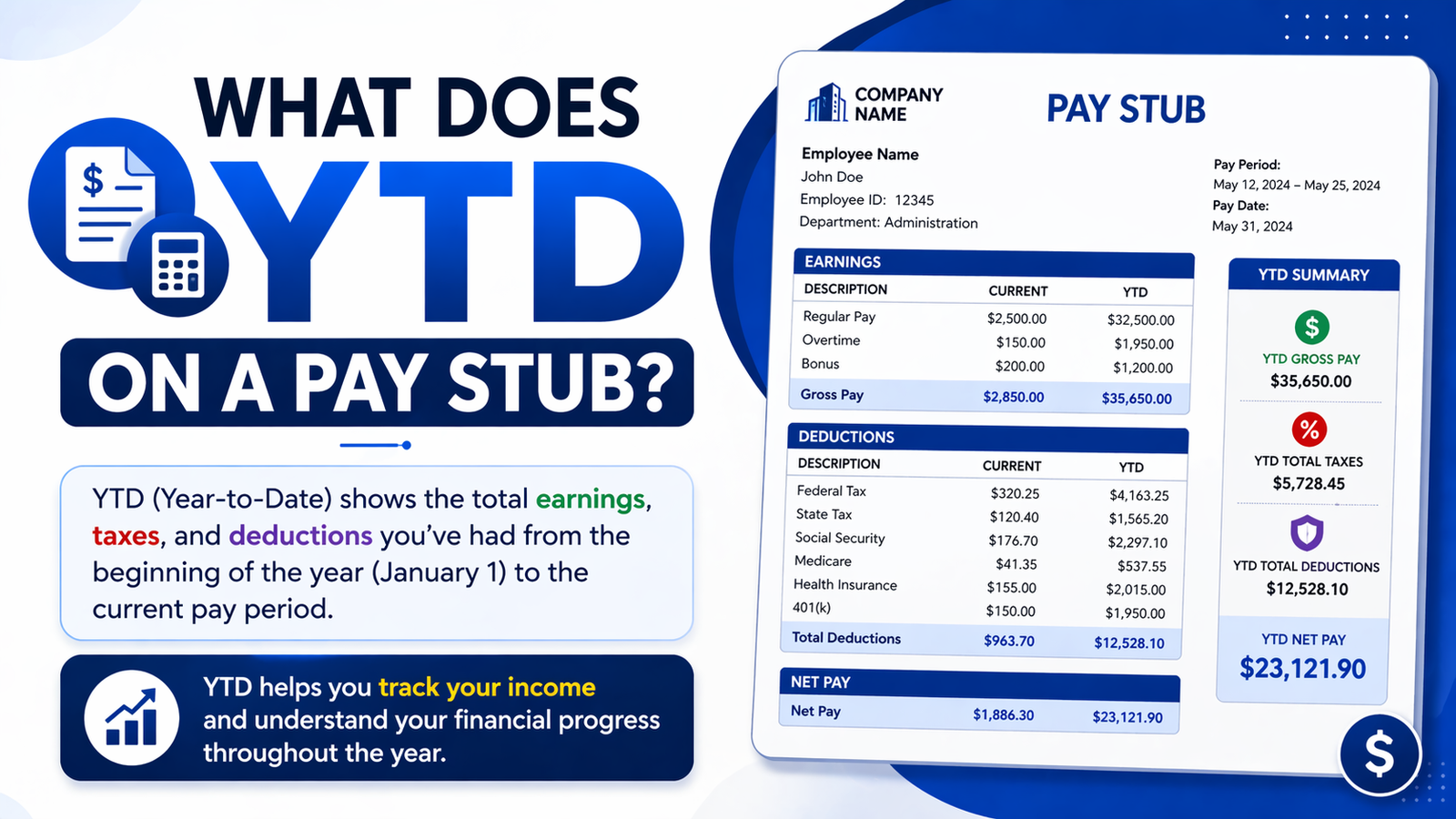
Year-to-Date (YTD) on a pay stub shows the total earnings, taxes, and deductions accumulated from the beginning of the year to the current pay period. It helps employees track their income and understand how much they’ve earned and paid in taxes so far.
If you were looking for year-to-date and have landed here, you are at the right place. This guide focuses on ytd and what is mean on a paystub. If you are looking for a reliable check stub generator, you can streamline your paystub tasks with our fast and user-friendly tool.
What is year to date?
Year-to-Date (YTD) means how much the employee has earned and how much the employer has deducted so far this year. It provides a total of your earnings, deductions, and paystub information.
What does year-to-date mean?
YTD stands for “year-to-date” period runs from the first day of January up to the current date. Some firms follow a fiscal year instead of a calendar year, so the YTD might start on a different date. The pay stub displays YTD information, which showcases a total of earnings, taxes, and deductions for the current year.
Think of YTD as a total that updates each time you get paid, which is paid biweekly. Your YTD grows 26 times a year. YTD simply means Year-To-Date. You will get to see this abbreviation multiple times on your paystub. YTD appears in:
- Pay stubs
- Account statements
- Financial reports
- Tax documents and W-2 forms
The point to focus on is that YTD starts on the beginning date of the calendar year.
Types of YTD
Your pay stub contains various YTD indicators. Below, we have mentioned what each term means.
YTD Gross Pay
This indicates your overall profit before any deductions. Repayment includes all types of payments. This means your fundamental revenue, time after regulation work, bonus bills, and commission earnings.
YTD Net Pay
This is the final amount that you get to take home. The bank account received this money. YTD net pay equals YTD gross minus all taxes and deductions.
YTD Taxes
The document shows your entire federal, state, neighborhood, and FICA tax deductions. The breakdown reveals the entire amount for each tax category. FIT helps you experience federal withholding amounts by understanding taxable wages.
YTD Deductions
Your deductions fall into two categories:
- Pre-tax deductions: Includes 401(k) contributions, HSA contributions, and medical health insurance rates.
- Post-tax deductions: Includes Roth 401(k) loans, wage garnishments, union membership fees, and court-ordered wage forfeiture.
YTD Hours
For hourly people, the YTD hours monitor normal hours worked from the beginning of the year. The system displays units for each day-to-day working hour and overtime observances. This allows us employees to confirm total earnings from all labor hours.
How to Calculate YTD?
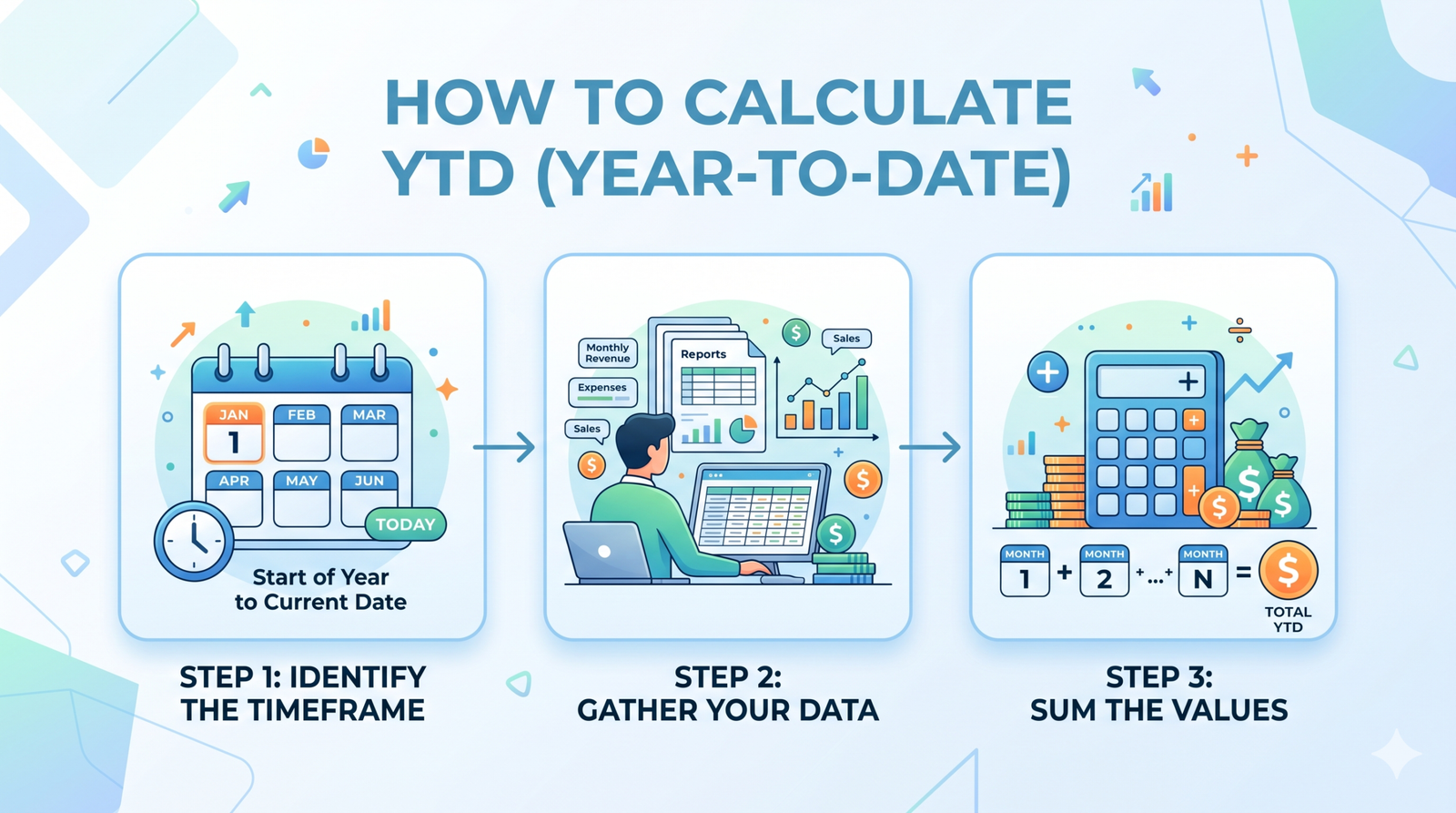
Calculation of YTD is easy to understand once you know its principle. Below, we have mentioned its basic principle as well as a real-life calculation example:
Basic Formula:
1- Begin with the value from the first day of the year
2- Add up all values through the current date
3- Total equals your YTD figure
Real-Life Calculation Example:
Peter earns $3,000 per biweekly paycheck. After receiving six paychecks by March 15, his year-to-date (YTD) gross pay is $18,000.
His FICA contributions (Social Security and Medicare) total 7.65% of his earnings, which equals $1,377.
Federal income tax is calculated using progressive tax brackets, so instead of a flat 22%, his effective tax rate would be lower, typically falling within the 10% to 12% range at this income level.
After estimated deductions, his net pay would be higher than a flat 22% calculation suggests.
With each pay period, these YTD totals keep increasing. The first thirty numbers of December showcase your entire performance for the entire year. On the primary day of the new year, the calculator resets all values to zero. Then it starts its new cycle.
Pro Tip: With our free paystub template, you can generate professional pay stubs by choosing your desired template, which then serves as proof of income for loan applications.
What does YTD mean on a pay stub?
YTD on your pay stub means you get to see Year-To-Date (YTD) earnings and deductions information. This covers the first half of January via the present pay date. Your yearly performance monitoring shows labels like YTD Federal Tax and YTD net pay.
Your final pay stub, which arrives in December, shows YTD gross earnings that should be equal to Box 1 on your W-2. If that information does not match, you should reach out to your HR department before the tax season begins.
What Does YTD Mean in Finance?
Monitoring your YTD provides you with financial information that pays off in various ways, like:
Detect Payroll Errors Early
You need to review your projected YTD income by multiplying your payroll by the number of hours worked and pay periods. Then, compare the whole to the actual values on your pay stub. If the numbers are not in shape now, check immediately. Over the years, small mistakes can turn into major troubles.
Plan for Tax Season
Review your YTD tax withholding at the midpoint of the year. Additionally, you may need to regulate your W-4 form. It is probably dropping too much tax or not leaving enough tax. This can lead to huge tax bills or huge tax refunds.
Monitor Budget Progress
The YTD income document presents the financial results of your enterprise since the beginning of the year. This determines your accomplishment in reaching your objectives for each year. Performance monitoring helps adjust June’s prices. This is easier than realizing your dreams are impossible to reap in December.
Document Income for Applications
Lenders and landlords will require YTD income documentation to confirm your financial details. Understanding What does year to date mean? might come in handy when you are explaining your payslip details to them.
Entrepreneurs use YTD reports to see how their present expenses stack up against the annual budget. This is very handy in making decisions related to personnel and the financial department.
Are you tired of calculating YTD manually?
Track your earnings, deductions, and YTD totals effortlessly with our all-in-one paystub generator.
What are the different types of YTD values?
YTD can be used to describe various forms of income and deductions on your pay stub. Below, we have curated 4 main types of YTD values:
1- Returns: It is used to monitor profit or loss from investments. This value helps employees assess financial performance over the course of the year.
2- Gross pay: This shows an employee’s total salary before deductions are applied.
3- Net Pay: This is the amount that an employee takes home.
4- Earnings: This figure displays a worker’s total income for the economic year, covering base income, overtime, investment returns, and any additional income
Common Mistakes to Avoid
Look out for the common mistakes:
1- The difference between gross income and net YTD is confusing
Gross pay is before deductions; net pay is what you take home. The loan application process demands a full YTD gross income and not your net income.
2- Forgetting to reset
YTD returns with zero on the first day of the calendar year. A pay stub from December will showcase much higher YTD than one from early January.
3- Mid-year job change
If you switch jobs at some point during the year, your new employer, through their YTD document, very easily shows the bill they created for a modern-day 12-month period. You want to merge the 12 months of benefits to date from all of your employers for tax purposes.
4- Handling YTD as final
The YTD is incomplete as of December 31. Your modern-day YTD benefit is not included in your overall annual compensation. You can receive profit increases and overall performance bonuses to be able to influence your projected income.
Generate Professional Pay Stubs with our Pay Stub Generator Free
To make sure your earnings, taxes, and deductions are accurately tracked, it’s important to understand the key terms on your pay stub. For employers, calculating precise year-to-date (YTD) figures isn’t just a task; it’s essential for maintaining smooth and compliant payroll operations.
If you’re looking for a simple and budget-friendly solution, Paystub Generator Free makes the process effortless. With its easy-to-use online platform, you can generate accurate, professional pay stubs in just a few quick steps, with no technical hassle involved.
The best part? There are no hidden charges, and your data stays completely private and secure. Whether you’re an employee or a business owner, our check stub generator helps you manage payroll with confidence and ease.
Key Takeaways
Understanding What is the meaning of year to date? will give you more control over your financial situation. The YTD data on your paycheck indicates the total amount of money you have made and the total amount that has been deducted for taxes to date. Continuously monitoring your YTD figures over the course of the year helps you identify any errors or inconsistencies early on, before the tax season starts. If you keep track of your pay stubs every month, you will be less likely to face problems in the future.
Proof of payment is required to establish the earnings obtained through freelance work and self-employment. Our paystub generator can be used to quickly and accurately create pay stubs.
FAQs
1- Is YTD before or after taxes?
To calculate YTD (Year to Date), you want to feature all benefits, taxes, and deductions from the beginning of the calendar year to the current pay period.
2- What is YTD in salary slip?
The Year-in-Date(YTD) payroll provides a comprehensive summary of the employee’s usual benefits and deductions for 12 months from the beginning of the current calendar year to the date of that payroll.
3- What is Year to Date meaning?
Year-to-date (YTD) refers to a period starting on the primary day of the state-of-the-art calendar or fiscal year (e.g., January 1) as a prevailing date
4- What is YTD?
YTD is defined as the period starting from the first day of the current calendar year to the present date.
5- Is a high YTD return good?
Not always. A high YTD return means the fund has done nicely recently; you may want to see beyond that if it has been consistently accomplished over the years.
6- How to calculate your YTD income?
To calculate YTD benefits, employers upload together all gross income from January 1 to the current date, which includes salary and differential reimbursement.
7- Can YTD be negative?
Yes, YTD can be negative if the current value is lower than the starting value.
8- What does YTD mean in HR?
YTD in HR means from the beginning of the modern year to the present time or to a specific date before the end of the year.
9- Is YTD monthly income?
The YTD NET abbreviation on a paystub shows the total annual amount for income and taxable deductions for each employee.
10- What is YTD Basic in payslip?
Year-to-date (YTD) data on the payroll provides a clear photograph of overall earnings, taxes and deductions due to the start of the year, enabling you to be accurate with payroll, comply with tax obligations, and move in the right direction with monetary planning.
11-What does YTD mean?
YTD (Year-to-Date) shows the total amount of money earned and deducted from January 1 to the current date.